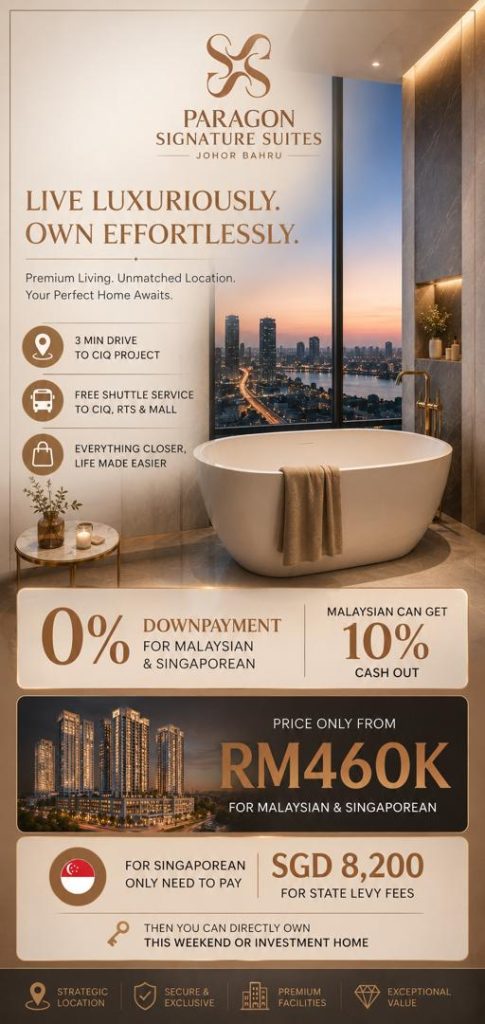
A Singaporean prepared with SGD8,500 may be able to begin the process of owning a condominium in Johor Bahru, but that amount should be understood as an entry fund, not the full cost of ownership. The distinction matters. A booking fee, legal costs, loan-related charges, furnishing decisions, and foreign-buyer rules can all shape how far that initial budget goes.
For cross-border buyers, Johor Bahru remains compelling because it pairs proximity to Singapore with a more accessible property market, expanding lifestyle districts, and the future convenience of the RTS corridor. The smarter question is not simply whether SGD8,500 is enough. It is whether the buyer has selected a qualifying property, structured the purchase correctly, and reserved sufficient funds beyond the first payment.
What SGD8,500 Can Cover for a Singaporean Buyer
At roughly RM27,000 to RM30,000 depending on exchange rates, SGD8,500 can potentially cover a booking fee or initial deposit for selected condominium opportunities. In some developer-led purchase structures, an initial payment may be designed to reduce the immediate cash required at reservation. That can make a compact city residence feel more attainable than buyers expect.
However, an initial payment is not the same as a completed purchase. Buyers should ask exactly what their payment covers: the booking amount, part of the down payment, legal documentation, stamp duty, loan processing, or a furnishing package. A clear answer protects the buyer from treating an attractive entry figure as the total capital requirement.
For a one-bedroom condominium, the appeal is practical. A manageable layout can suit a single professional, a cross-border commuter, a city pied-a-terre owner, or an investor seeking a more accessible rental format. But affordability comes from the complete ownership plan, not the headline booking amount alone.
Can a Singaporean Own a Johor Bahru Condo With SGD8,500?
Yes, a Singaporean can legally purchase certain condominium properties in Johor Bahru, subject to Malaysia’s foreign ownership requirements and the applicable Johor state rules. Yet SGD8,500 alone will generally not be enough to own the unit outright. It may be enough to secure an eligible unit at the start of the transaction, provided the buyer can meet the remaining payment obligations.
Foreign ownership rules are central to the decision. In Johor, foreign purchasers have commonly been subject to a minimum property price threshold, often around RM1 million for eligible residential properties. Requirements can differ by property category, location, title, project status, and current state policy. Buyers should obtain confirmation from the developer’s appointed sales team and a qualified Malaysian property lawyer before paying a booking fee.
This is especially relevant when a listing promotes a low initial payment. A low entry amount may be commercially attractive, but eligibility is determined by the property and the buyer’s legal status, not by the size of the first payment. A buyer should confirm that the specific unit is approved for foreign ownership and that all consent requirements are reflected in the sale and purchase documentation.
Build the Budget Beyond the Booking Fee
A condominium purchase is best assessed in stages. The first stage is the reservation amount. The second is the balance of the down payment and financing arrangement. The third is the cost of completing, operating, and enjoying the property.
Financing is often the biggest variable. Some Singaporean buyers use cash, while others explore financing through Malaysian banks, Singapore-based lending options, or private wealth arrangements. Loan margins, interest rates, income assessment, currency exposure, and documentation standards vary. A buyer whose income is earned in Singapore dollars should also consider how exchange-rate movement may affect any ringgit-denominated payments over time.
Completion costs deserve equal attention. These may include legal fees, stamp duties, valuation charges where applicable, loan documentation fees, state consent-related costs, and insurance. There can also be recurring commitments such as maintenance charges, sinking-fund contributions, assessment payments, utilities, internet, and furnishing refreshes.
A sensible buyer does not need to have every dollar in cash on day one. But they should have a written funding plan that shows how each stage will be paid. This approach turns an appealing SGD8,500 entry point into a credible ownership decision rather than a financial surprise.
Owner Occupation or Short-Term Rental Income?
The intended use of the property changes the numbers. A buyer who plans to stay in the condominium periodically may prioritize shuttle access, front-desk support, security, parking, a comfortable one-bedroom plan, and facilities that make short visits feel effortless. A buyer focused on rental income will look more closely at guest demand, distribution, operating costs, furnishing quality, building rules, and professional management.
Short-term rentals are not passive simply because a unit is listed online. Guest communication, check-in support, housekeeping, linen replacement, maintenance coordination, dynamic pricing, photography, listing management, and platform distribution all require consistent execution. An owner who manages these tasks personally may retain more direct control, but also takes on the operational workload.
A managed hospitality model can be a practical alternative for owners who want a more hands-off arrangement. At Paragon Signature Suites JB, the optional Aurum Stay program is designed around professionally managed short-term stays, with furnishing and interior design, guest support, housekeeping, maintenance, booking management, and monthly reporting handled through an organized operating structure. Owners receive 80% of net profit under the collective revenue-pool model, while management receives 20%, with shared cleaning, maintenance, and utility costs transparently allocated at 15%.
No rental model should be viewed as guaranteed income. Occupancy, nightly rates, tourism patterns, competition, building regulations, and operating costs will affect results. The stronger question is whether the property’s location, guest experience, and management capability support sustainable demand over time.
Why Compact Condominiums Make Sense for Cross-Border Buyers
Large homes can be appealing, but they are not always the most efficient choice for a first overseas property. A compact one-bedroom condominium can reduce furnishing scope, simplify upkeep, and appeal to a broad pool of potential users, including single professionals, business travelers, weekend visitors, and couples.
The best compact residences do not feel compromised. Look for layouts that separate the sleeping area from the living space, provide practical storage, include a functional kitchen setup, and make room for work or dining. Partially furnished units can also reduce the time between purchase and personal use or rental preparation.
Connectivity has value beyond travel time. A property with accessible routes to CIQ, the RTS connection, major malls, and established city amenities is easier for owners to enjoy and easier for guests to understand. Shuttle services can further strengthen the experience, particularly for guests unfamiliar with Johor Bahru.
Facilities should be evaluated with the same discipline. Dual-level lifestyle spaces, pools, fitness areas, social zones, and a 24-hour front desk may improve owner enjoyment and rental appeal, but buyers should assess whether the maintenance structure supports these amenities over the long term. GreenRE-certified features can also add appeal for owners who value more responsible building practices and efficient living.
Questions to Ask Before Paying the Initial SGD8,500
Before committing, request a written breakdown of the initial payment and the next payment milestones. Confirm the exact unit price, its eligibility for foreign ownership, the status of state consent, and the projected completion timeline if the property is under construction. Ask for estimated legal fees, stamp duties, maintenance charges, sinking-fund contributions, and any furnishing or management fees.
If rental income is part of the plan, ask how bookings are generated, which channels are used, how owner stays are handled, how expenses are allocated, and what appears in the monthly statement. It is also wise to understand the rules if an owner later wants to leave a rental program or sell the unit.
The most appealing property offer is one that remains clear after the sales presentation ends. SGD8,500 can be a meaningful way to start, but confidence comes from seeing the full path from reservation to completion, from key collection to long-term use. Choose a condominium that fits both your first payment and the life you expect it to support.