
A compact one-bedroom can be much more than a place to sleep between workdays or cross-border trips. The right furnished suites Johor Bahru proposition combines a private, polished residence with a practical way to participate in the city’s growing short-stay economy – without turning the owner into a full-time host.
That distinction matters. Many buyers are drawn to the idea of rental income, then discover that guest messaging, key handovers, cleaning coordination, pricing, and repairs are a second job. A hospitality-led suite changes the equation by pairing an owner-ready home with a professional operating structure. For urban professionals, first-time investors, and buyers connected to Singapore through CIQ and the future RTS corridor, it is a format designed for flexibility.
What Makes Furnished Suites Johor Bahru Different?
A furnished suite is not simply an apartment with a sofa and a bed. In a well-considered development, it is planned around how people actually use a city residence: arriving late, working remotely, storing essentials, entertaining casually, and leaving without worrying about an empty unit.
The strongest offerings balance three needs. First, the home must feel comfortable enough for owner occupation. Second, it should photograph and function well for short-stay guests. Third, the building must have operational support that makes frequent turnover realistic. A stylish interior alone cannot deliver that.
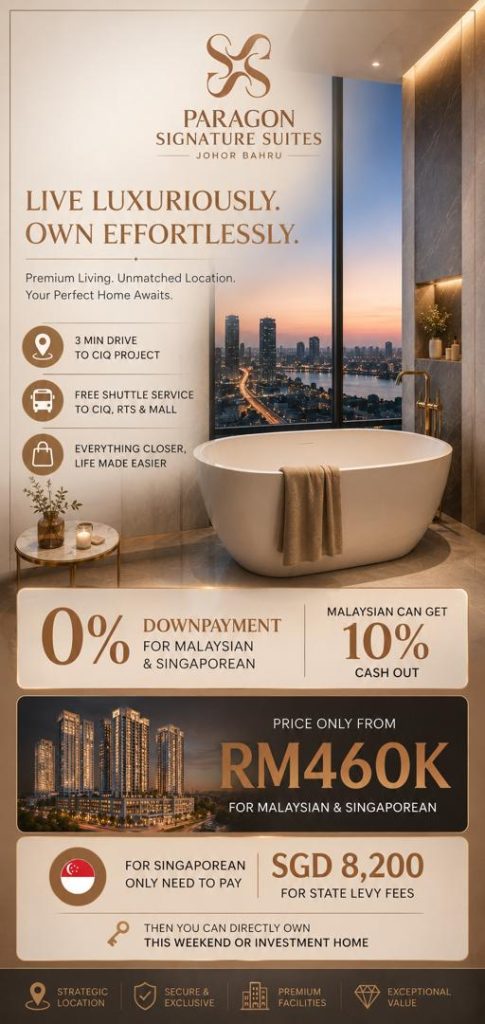
At Paragon Signature Suites JB, the one-bedroom Type A and Type B layouts span approximately 645 to 649 square feet. This gives buyers more room than the compact label may suggest, allowing for defined living, dining, kitchen, and bedroom zones rather than a space that feels like a hotel room. Type B is positioned exclusively for single dwellers, an option that may appeal to buyers who value a focused, low-maintenance personal residence.
There is an important point of clarity for buyers: partially furnished and fully guest-ready are not always the same thing. A partially furnished suite can provide the essential foundation for owner use, while a separate interior and furnishing solution prepares it for a consistent hospitality presentation. Ask exactly what is included at handover, what is optional, and what is needed before the suite can accept bookings.
A Home First, With Income Potential
Short-term rental potential is compelling, but it should be approached as a business model rather than a promise of automatic returns. Occupancy can shift with seasonality, regional events, border travel patterns, competing supply, nightly rates, and guest reviews. Buyers who understand these variables are better placed to assess whether a suite suits their financial goals.
The advantage of a managed model is not that it removes all market risk. It removes much of the operational friction. Instead of sourcing furniture, arranging photography, building listings, replying to late-night guest questions, and coordinating cleaners, an owner can appoint an experienced operator to manage the guest journey.
What professional short-stay management should cover
A complete hospitality program should go beyond listing a unit online. It should coordinate furnishing and interior styling, housekeeping, routine maintenance, booking management, distribution, guest support, and performance reporting. The quality of these details affects guest confidence, review scores, repeat stays, and ultimately the unit’s ability to compete.
For owners who want a hands-off approach, Aurum Stay provides this type of managed hospitality framework. The program includes guest-facing touches such as a 24-hour front desk, welcome drinks, and pre-cooled arrivals, alongside the less visible work that protects the owner experience: housekeeping coordination, maintenance support, and booking distribution across major travel platforms.
This model can be especially useful for Singapore-based owners. A property across the border may be close enough to enjoy regularly, yet far enough away that handling an urgent lock issue or a cleaning schedule personally becomes impractical. Professional management gives the property a local operating presence while the owner retains a personal city base.
Read the Revenue Structure, Not Just the Headline
Every rental proposition deserves careful reading. The central question is not only, “What can this suite earn?” It is also, “How are revenue, expenses, and responsibilities handled?” Clear answers reduce surprises after purchase.
Under a collective short-term rental revenue pool, owners may share in the performance of a professionally managed portfolio rather than depending only on the booking calendar of one individual unit. This can smooth out differences between locations within the building, guest preferences, or temporary maintenance downtime. It can also mean that individual control over how a specific suite is marketed is more limited. The better choice depends on whether an owner values shared operational consistency or complete autonomy.
The Aurum Stay framework states that owners receive 80% of net profit and management receives 20%. Shared operating costs are allocated transparently at 15% for cleaning, maintenance, and utilities. Those figures provide a useful starting point, but buyers should still request a clear explanation of what “net profit” includes, how statements are prepared, how vacant periods are treated, and whether any additional costs apply.
A thoughtful investor also considers personal use. Some programs offer complimentary owner stays, which can add meaningful lifestyle value for buyers who expect to visit Johor Bahru often. Confirm the booking rules, blackout periods, notice requirements, and whether owner stays affect pooled revenue. Flexibility has value, but it works best when the rules are known before signing.
Why Location and Building Operations Work Together
A desirable address helps, yet access alone does not create a guest-ready property. The full experience begins when a guest decides whether the suite is convenient for a business trip, a weekend shopping visit, a medical appointment, or a cross-border stay. It continues with the arrival process, the condition of the unit, and the ease of moving around the city.
Shuttle connectivity to destinations such as KSL, Mid Valley, RTS, and CIQ strengthens the practical appeal for both owners and guests. For an owner, this can mean less reliance on daily driving. For a guest, it adds a clear reason to choose a professionally managed suite over an isolated residential unit.
Building facilities matter in the same way. Dual-level lifestyle spaces can make a one-bedroom home feel more expansive, offering places to exercise, recharge, socialize, or work outside the suite. However, buyers should look beyond facility renderings. Consider operating hours, access controls, maintenance plans, crowding at peak times, and the monthly fees that support the amenity package.
Sustainability also deserves more than a passing mention. A GreenRE-certified development signals attention to environmental performance and responsible building practices. For residents, that can support a more considered daily living environment. For investors, it can strengthen the long-term relevance of the property as buyers and guests become more selective about how buildings are designed and operated.
Questions to Ask Before Choosing Your Suite
Before committing to a furnished or partially furnished suite, focus on details that shape real ownership. Confirm the unit’s usable layout, storage, orientation, furnishing scope, and expected handover condition. A floor plan may look generous, but placement of wardrobes, appliances, and work surfaces will influence how the space lives day to day.
Then examine the rental operation with the same care. Ask who controls pricing, where listings will appear, how guest damage is handled, how often statements are issued, and what happens when maintenance is required. If you are considering a pooled model, request examples that show the flow from gross booking revenue to operating costs and owner distribution.
Finally, consider your own purpose. A buyer who plans frequent personal stays may prioritize comfort, a preferred view, and owner booking access. A buyer focused on passive income may care more about management depth, distribution reach, and transparent cost allocation. Neither approach is wrong. The right suite is the one whose design, operating model, and level of involvement match how you genuinely intend to own it.
A well-run furnished suite should leave room for both ambition and ease: a contemporary home when you need it, and a professionally cared-for asset when you are elsewhere.
One Response