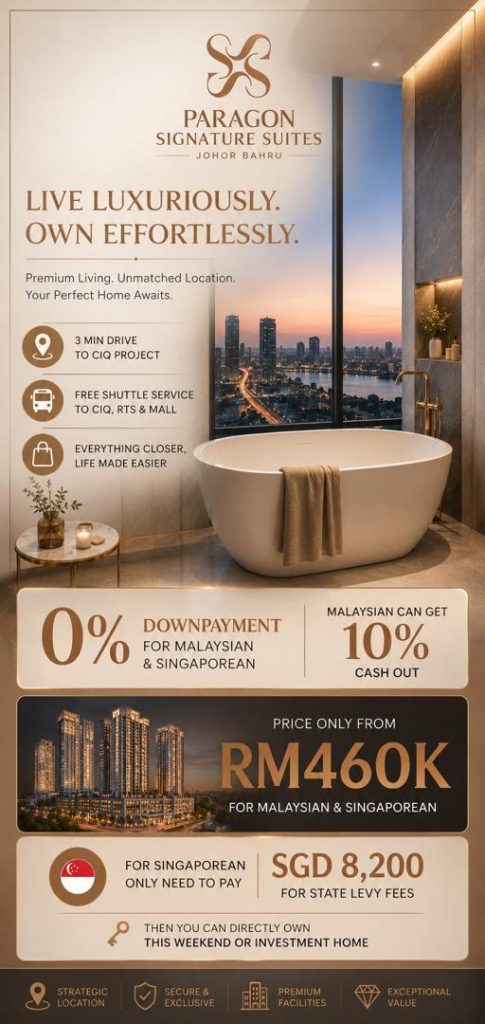
A one-bedroom suite in Johor Bahru is no longer competing only for a traditional 12-month tenant. Johor rental demand is increasingly shaped by cross-border commuters, weekend visitors, corporate travelers, relocating professionals, and guests who want the privacy of a home with hotel-style convenience. For investors, that creates opportunity – but only when the unit, location, and operating model match the type of stay being pursued.
The most useful question is not whether rental demand exists. It does. The better question is which demand segment a property can serve consistently, and what it takes to convert interest into recurring income.
Johor Rental Demand Is Being Shaped by Mobility
Johor Bahru benefits from a rare mix of local city activity and Singapore-linked movement. The CIQ corridor, the planned RTS connection, business travel, medical visits, family trips, shopping weekends, and event-based stays all create reasons for people to enter and move around the city. This gives the rental market more layers than a location dependent on a single tenant profile.
Cross-border connectivity matters because time has value. A visitor arriving from Singapore may choose a short stay to avoid repeated travel, while a professional with frequent appointments in Johor may prefer a furnished suite over a conventional lease. The same logic applies to buyers who want a personal city base while retaining the option to generate income during unused dates.
Still, connectivity alone does not create bookings. Guests and tenants compare the full journey: travel time, pickup options, nearby retail, parking, check-in reliability, and the quality of the unit itself. A property that is well positioned but difficult to access can lose demand to a more convenient alternative.
Demand Is Not One Rental Market
Investors often use the term “rental demand” as if every renter has the same needs. In practice, Johor Bahru has several overlapping audiences, and each responds to a different offer.
Short-stay guests value convenience and confidence
Short-stay guests may be in town for a quick shopping trip, a family visit, work, or a short break from Singapore. They tend to prioritize clear arrival instructions, responsive guest support, clean interiors, strong Wi-Fi, comfortable bedding, and an easy digital booking experience. A polished listing can generate attention, but guest reviews and operational consistency determine whether it continues to perform.
For this group, a partially furnished or professionally styled one-bedroom can be especially appealing. It provides more space and privacy than a hotel room while maintaining the familiar comforts guests expect from hospitality accommodation.
Mid-term occupants want flexibility without compromise
Some demand comes from people staying for weeks or a few months: project-based workers, relocating professionals, families between homes, or individuals testing a new work routine. These occupants usually care more about storage, kitchen usability, laundry access, workspace potential, and a calm residential setting.
A compact one-bedroom unit can work well here when the layout feels intentional. Square footage matters less than whether the resident can sleep, work, cook, and unwind without the space feeling temporary or crowded.
Long-term tenants still provide stability
Traditional tenants remain an important part of the market, particularly professionals and single dwellers who want a contemporary home near daily conveniences. Long-term leasing may offer more predictable occupancy and fewer turnover costs, though it can limit an owner’s ability to use the unit personally or adjust rates during high-demand periods.
There is no universally superior strategy. Short-term rental can offer more pricing flexibility but requires stronger operations. Long-term rental may be simpler, but the income ceiling and owner flexibility may be lower. The right choice depends on the unit’s location, an owner’s risk preference, and whether professional management is available.
What Converts Interest Into a Booking or Lease
A good address gets a property onto a renter’s shortlist. The actual decision is usually made through the details. In a competitive market, guests and tenants want to see that a property has been designed around real use rather than simply furnished for photographs.
For short stays, first impressions are operational. Fast responses, a smooth check-in, a clean arrival, and clear support can carry as much weight as a gym or a pool. For longer stays, practical features such as a functional kitchen, built-in storage, comfortable seating, and reliable maintenance often matter more than decorative extras.
Facilities can strengthen the value proposition when they are genuinely usable. Dual-level lifestyle spaces, areas for relaxation, fitness amenities, and a welcoming lobby experience help a smaller private suite feel like part of a complete residential environment. Sustainability credentials can also be meaningful to buyers and occupants who are increasingly conscious of energy use and long-term building quality.
Location Must Work Beyond the Map Pin
Investors should look at access in practical terms rather than relying on a radius drawn around a landmark. Is there a dependable route to shopping centers, city destinations, and transport nodes? Can a guest who has never visited Johor Bahru understand how to arrive? Is there a shuttle option, available parking, or a straightforward ride-hailing pickup point?
This is where a managed development can create an advantage. A shuttle connection to destinations such as KSL, Mid Valley, RTS, and CIQ can make a location easier to use, particularly for visitors without a car. It also gives property managers a clearer story to communicate across booking platforms.
However, investors should avoid assuming that every nearby landmark produces demand. A mall may create weekend interest, while a business district may support weekday stays. A property close to border access may appeal to Singapore-linked travelers, but it still needs the right accommodation standard and rate positioning to win the booking.
The Economics Behind Short-Term Rental Demand
Demand is only valuable when it can be captured efficiently. Gross booking revenue is not the same as owner income. Cleaning, utilities, maintenance, platform distribution, replacement of linens and furnishings, guest communication, and vacancy periods all affect the final result.
That is why a rental plan should be assessed like an operating business. Investors should ask how the unit will be styled, who sets rates, where listings will appear, how reviews are managed, and how costs are reported. They should also understand whether the operator has enough inventory and systems to maintain consistent standards during busy periods.
Monthly statements are particularly valuable because they turn a broad income promise into measurable performance. An owner should be able to see booking activity, revenue, operating deductions, and the basis for the final distribution. Transparency does not remove market risk, but it gives owners a clearer basis for evaluating results and making decisions.
Johor Rental Demand Also Has Supply Risk
The city’s appeal has encouraged new residential supply, especially compact apartments marketed toward investors. That means a unit cannot depend on the market alone. Similar floor plans, similar photos, and similar facilities can compete for the same guest or tenant.
The differentiator is often execution. A better-designed interior, professional photography, hospitality-level housekeeping, responsive support, and disciplined pricing can help a unit stand out. Yet investors should remain realistic: seasonal demand, economic conditions, travel patterns, and competing supply can influence occupancy and rates. Rental returns should be considered a variable outcome, not a guaranteed number.
A small-format unit also needs to be selected carefully. For example, a one-bedroom layout around 645 to 649 square feet can offer a more comfortable experience than a studio, but it must still fit the intended audience. A suite designed exclusively for a single dweller may be ideal for professionals and solo guests, while couples or small families may favor a different configuration.
A Managed Model Can Turn Demand Into a Service
For owners who want rental exposure without handling day-to-day guest operations, the management structure matters as much as the property. Paragon Signature Suites JB addresses this through Aurum Stay, a managed hospitality program covering furnishing coordination, interior design, distribution, reservations, guest support, housekeeping, and maintenance.
Its collective short-term rental approach is designed around a transparent framework: owners receive 80% of net profit, management receives 20%, and shared operating costs for cleaning, maintenance, and utilities are allocated at 15%. The appeal is not simply hands-off ownership. It is having a defined system for presenting the suite, serving guests, and reporting performance rather than asking each owner to build those capabilities independently.
For a buyer with a busy career, cross-border commitments, or limited experience in hospitality, that operational support can make the short-term rental path more practical. For a hands-on investor, it also creates a useful benchmark for comparing the real cost of self-management.
The strongest rental decision starts with a clear use case. Choose a unit that you would be comfortable occupying yourself, then assess whether its access, layout, guest experience, and management model give other people a compelling reason to stay there too. That is where demand becomes more than a market statistic – it becomes a property positioned to earn its place in a guest’s itinerary or a tenant’s routine.