At the border, time is becoming a form of currency. Singapore Malaysia commuter trends are no longer defined only by who crosses the Causeway each morning. They now shape where professionals choose to stay, how investors assess rental demand, and why compact, well-managed residences in Johor Bahru are attracting closer attention.
For buyers, the opportunity is not simply to own a property near Singapore. It is to understand the changing behavior behind cross-border movement: flexible work schedules, rising living-cost awareness, weekend travel, improved rail connectivity, and a growing preference for homes that can serve both personal and hospitality purposes.
Singapore Malaysia Commuter Trends Are Changing Housing Demand
The traditional cross-border routine was straightforward: live in Johor Bahru, work in Singapore, and accept a long daily commute in return for a lower cost of living. That pattern remains relevant, especially for workers in sectors with fixed on-site schedules. But it is no longer the only driver of demand.
Hybrid work has created a wider range of commuter profiles. Some professionals cross several days a week rather than five. Others maintain a Johor Bahru base while using short stays in Singapore during demanding work periods. Singapore residents, meanwhile, increasingly make purposeful trips north for dining, shopping, wellness, family visits, and short breaks. These patterns create demand that moves beyond the conventional long-term tenant.
For a residential investor, this matters because a unit’s appeal may come from several guest and occupant segments rather than one. A one-bedroom residence may suit a cross-border professional seeking a practical weekday base, a single dweller wanting city access, or a short-stay guest looking for more space and privacy than a hotel room provides.
That does not mean every property near the border will perform equally. The strongest demand tends to favor developments that remove friction: convenient transport options, a recognizable neighborhood, reliable building operations, quality furnishings, and a guest experience that feels considered from arrival onward.
Convenience Has Become More Valuable Than Distance Alone
Buyers often begin with a simple question: how close is the development to CIQ or the future RTS Link? Proximity is useful, but the better question is whether the journey works in real life.
A location can look close on a map and still feel inconvenient if residents face inconsistent pickup arrangements, limited nearby services, or an awkward last-mile connection. Conversely, a well-organized shuttle route and access to established destinations can make a slightly less central address more practical for daily living and short stays.
The RTS Link is particularly significant because it changes the conversation from road-based uncertainty to rail-based predictability. Its impact will depend on final operating patterns, station access, and traveler adoption, but its strategic value is already influencing how buyers evaluate the Johor Bahru-Singapore corridor. Properties that provide practical access to RTS, CIQ, retail centers, and lifestyle areas are positioned for a broader pool of potential occupants.
For owner-occupiers, that connectivity supports a more balanced routine. For investors, it can support wider booking appeal. A guest who can reach key transit points without arranging a private car is more likely to view a stay as convenient, especially for a short business trip or a weekend visit.
The commute is becoming a lifestyle decision
The new commuter does not necessarily want the cheapest possible unit. Many want a living environment that gives them back time and energy after border travel. That includes a comfortable layout, efficient air conditioning, dependable Wi-Fi, a functional workspace, on-site facilities, and responsive support when something needs attention.
This is why hotel-style residences have a growing role in the market. They offer a middle ground between a purely private apartment and a conventional hotel. The guest receives more independence and residential comfort, while the owner benefits from professional standards that can help protect the experience and the asset.
Short-Stay Demand Has a Different Rhythm
Cross-border rental demand is not one market. Weekday corporate travel, Singapore holiday traffic, event-driven stays, medical and family visits, and local staycations each have different booking windows and price sensitivity.
A commuter-focused stay may value early check-in flexibility, pre-cooled rooms, luggage convenience, and a fast route to transit. A weekend guest may focus more on facilities, nearby malls, food destinations, and the overall feel of the suite. The property that tries to appeal to everyone with generic furnishing can miss both audiences.
Instead, investors should look for units designed around real usage. A compact one-bedroom layout of roughly 645 to 649 square feet can offer a meaningful advantage over a standard hotel room when it includes distinct spaces for sleeping, relaxing, dining, and working. For single dwellers and couples, that format can feel efficient without feeling temporary.
Operational management is equally important. Short-term rental revenue is not created by listing a unit online and waiting for reservations. It depends on photography, pricing, guest communication, cleaning coordination, maintenance response, review management, and distribution across booking channels. Owners who want hands-off income need to assess who will handle these moving parts and how performance will be reported.
Why transparent management matters
A revenue-sharing program can be attractive, but the structure deserves careful attention. Buyers should understand the split of net profit, the allocation of shared operating costs, the services included, and how often they will receive statements. Clear reporting does not guarantee a specific return, because occupancy and rates will always move with market conditions. It does give owners a better basis for evaluating performance.
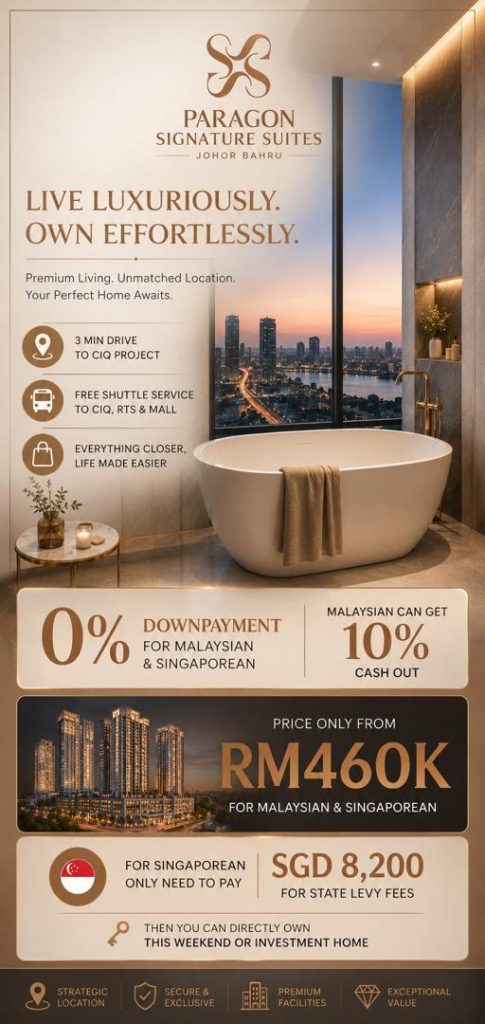
At Paragon Signature Suites JB, the Aurum Stay model is built around managed hospitality operations, from furnishing and booking management to housekeeping and guest support. For buyers who do not want to personally coordinate late-night arrivals, cleaning teams, or listing updates, that type of structure can turn a residential purchase into a more practical income-oriented asset.
Sustainability Is Becoming Part of Buyer Value
Sustainable living is sometimes treated as a branding feature, but it increasingly affects the practical side of ownership. Efficient building operations, thoughtful common-area design, and responsible resource use can contribute to a property’s long-term relevance, particularly as buyers become more selective about operating costs and building quality.
Green-certified developments may also appeal to a newer class of traveler and tenant who expects comfort without unnecessary waste. This is not usually the first reason someone books a one-bedroom suite, but it can strengthen a development’s overall position when combined with location, design, and service.
For investors, the key is to avoid treating sustainability as a substitute for fundamentals. A green credential cannot compensate for poor access, weak management, or a layout that does not suit market demand. It works best as part of a complete proposition: efficient living, credible operations, and a guest experience that supports repeat stays.
What Buyers Should Watch Next
The cross-border corridor will continue to evolve, and the most useful signals may be behavioral rather than headline-driven. Watch whether commuters choose rail over road as new infrastructure becomes available. Watch whether flexible work stabilizes at two or three office days rather than returning to a full five-day pattern. Watch short-stay booking demand around school holidays, long weekends, concerts, exhibitions, and major retail periods.
It is also worth watching the balance between owner occupation and hospitality use within a development. A building with too little operational consistency can struggle to create a premium impression, while one with overly restrictive use may limit flexibility for owners. The right fit depends on your objective: a personal residence, a part-time city base, or an income-producing suite with professional management.
The most compelling properties will not rely on border proximity alone. They will offer a more complete answer to the way people now move between Singapore and Johor Bahru: less predictable than before, more lifestyle-led, and increasingly focused on convenience at every stage of the journey.
For a buyer, that is the real opportunity. Choose a residence that works not only for the commute you can see today, but for the flexible cross-border living patterns that are already taking shape.