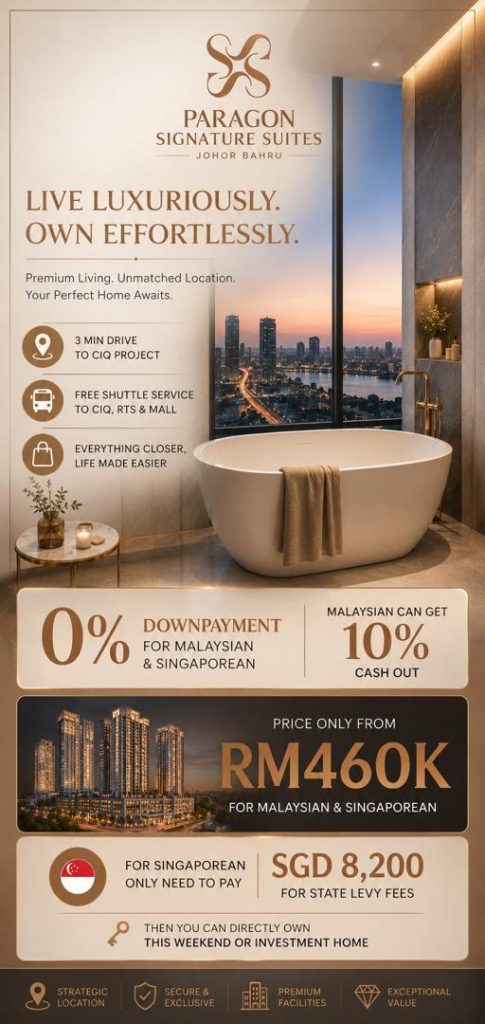
A lower purchase entry point in Johor Bahru can look compelling from a Singapore office desk. But a home across the border is not simply a cheaper version of Singapore living. This Singapore commuter housing guide is designed for buyers who want to assess the daily reality: border timing, last-mile transport, unit usability, and whether the property can also work as a professionally managed income asset.
The best decision starts with a clear distinction between a commuter home and an occasional city escape. A buyer who crosses the border four or five days a week needs a very different location, building setup, and personal routine than an investor who expects weekend use and short-term rental demand.
Start With the Commute, Not the Brochure
For cross-border buyers, the route to Singapore determines much of a property’s long-term appeal. The key question is not just how close a development is to the CIQ or RTS corridor on a map. It is how predictable the journey remains during weekday peaks, public holidays, rain, school breaks, and major event periods.
A property with planned or available shuttle connectivity to key city points, the CIQ, shopping districts, and future rail connections can remove part of the friction. Still, no shuttle service makes border congestion disappear. Buyers should treat commuting time as a range rather than a fixed promise and build a realistic buffer into their working day.
Before committing, test the journey at the hours you expect to travel. Drive or take public transportation from the development to the checkpoint, cross the border, and continue to your workplace or preferred transit station. Repeat the exercise in the opposite direction. One convenient Saturday viewing cannot reveal the experience of a Tuesday morning commute.
A practical route test should account for four separate stages:
- Time from your unit to the pickup point, parking area, or road exit
- Travel time to the checkpoint, including typical traffic conditions
- Immigration clearance and onward Singapore transport
- The return journey, especially after evening peak hours
This is where expectations matter. A Johor Bahru residence may offer more interior space and a more approachable ownership cost, but the trade-off is dependence on border conditions. For professionals with flexible schedules, hybrid work arrangements, or nontraditional hours, that trade-off can be highly workable. For someone required to be at a Singapore desk at the same time every morning, proximity and transport planning become non-negotiable.
Choose a Home That Works on Ordinary Weekdays
A compact one-bedroom can be a strong format for a commuter, particularly for a single buyer or couple who values a manageable home over excess square footage. The layout must still support real life after a long border crossing. Look beyond the staged furniture and consider where luggage, work items, groceries, laundry, and daily essentials will go.
A suite in the 645 to 649 square foot range can provide a more livable sense of separation than a micro-unit, with room for a bedroom, living area, kitchen functionality, and a dedicated work corner. That flexibility matters because a commuter home may need to become an occasional remote-work base, a recovery space after a late arrival, or a weekend residence for visiting friends and family.
For single dwellers, a unit type positioned specifically around one-person living can be especially efficient. The right choice depends on whether you prioritize privacy, a larger living zone, entertaining space, or a work setup. Ask for the actual floor plan, furniture plan, and storage details rather than relying on a rendered image alone.
Partially furnished homes can reduce the effort of moving in, but buyers should be precise about what is included and what remains to be purchased. Evaluate air-conditioning, kitchen fittings, wardrobe capacity, internet readiness, window orientation, noise exposure, and practical maintenance needs. These details influence both personal comfort and a future guest’s review of the stay.
Facilities Should Support Your Schedule
Lifestyle facilities add value when they fit the rhythm of the owner or guest. A gym, pool, lounge, work-friendly common area, and 24-hour front desk can make a compact residence feel more complete. Dual-level facilities can also spread activity across the building, giving residents options without requiring a long trip into the city.
For a commuter, the most valuable feature may be less glamorous: an orderly arrival experience. Secure access, a staffed front desk, reliable pickup arrangements, parcel handling, and well-maintained common areas reduce daily friction. If you arrive late from Singapore, a building that feels operationally prepared is more valuable than an oversized facility deck used only occasionally.
Sustainability is also worth examining beyond a marketing label. A GreenRE-certified development can appeal to buyers who want a more responsible home and may signal attention to building efficiency. Ask what the certification covers and how operating practices, utility use, and maintenance are managed over time. The practical value lies in the building’s ongoing performance, not the badge alone.
Singapore Commuter Housing Guide: Buy With Two Uses in Mind
Many cross-border buyers want a residence they can occupy now and rent later. That can be a sensible strategy, but it requires a property that serves both audiences without compromising either one. Owner-occupiers want comfort, access, and a home they are proud to return to. Short-term guests want easy arrival, polished interiors, responsive support, and clear booking information.
A hotel-style condo model can bridge those needs when the rental operation is structured professionally. Rather than furnishing a unit independently, answering guest messages at midnight, coordinating cleaners, and monitoring calendar rates, an owner may prefer a managed hospitality program. The strongest versions cover interior design, furnishing, housekeeping, maintenance, guest support, distribution, and booking management.
At Paragon Signature Suites JB, the Aurum Stay approach is built around this hands-off ownership model. Owners can participate in a collective short-term rental revenue pool, with 80% of net profit allocated to owners and 20% to management, while shared operating costs are clearly identified. Transparent monthly statements are not a minor administrative detail. They are essential for an investor who needs to understand performance, expenses, and the difference between gross bookings and actual net income.
That said, rental income should never be treated as guaranteed. Occupancy changes with tourism, business travel, border conditions, competing supply, seasonal events, pricing strategy, and platform visibility. Buyers should ask how units are marketed across relevant travel platforms, how rates are set, what owner-use rules apply, and what happens during softer demand periods.
Know the Rules Before You Price the Returns
Foreign buyers should obtain current legal and financial advice before purchasing Malaysian property. Minimum purchase thresholds, approval processes, taxes, financing availability, currency exposure, and ownership requirements can change. The same applies to short-term rental operations: building rules, local requirements, and operational permissions should be verified before rental projections are treated as part of an investment case.
Currency is a meaningful consideration for Singapore-connected buyers. Your purchase, maintenance costs, and rental income may be in Malaysian ringgit, while your salary, savings, or financial obligations may be in Singapore dollars. Exchange-rate movement can affect the real cost of ownership and the value of income when converted back. This is neither automatically favorable nor automatically risky. It depends on your holding period, financing structure, and personal currency needs.
Also review recurring costs with the same discipline used for the purchase price. Maintenance fees, sinking fund contributions, utilities, insurance, furnishing replacement, program fees, cleaning allocation, and vacancy periods belong in the numbers. A credible investment model shows both the attractive scenario and the quieter months.
Build a Decision Around Your Actual Week
The right commuter property is rarely the one with the longest feature list. It is the one that makes your specific routine easier while retaining optionality. If you are buying for personal use, prioritize the commute and the comfort of the unit. If you are buying as an investment, prioritize operational capability, rental positioning, reporting transparency, and realistic demand assumptions. If you want both, do not accept a compromise that performs poorly at either.
Visit at different times, inspect the route, ask direct questions about management, and compare total ownership costs rather than headline prices. A well-chosen Johor Bahru suite can offer a refined base near Singapore and a practical path to managed rental participation. The real advantage comes when the home fits the way you intend to live, travel, and invest long after the first viewing.