
A Johor Bahru property can place Singapore-connected city living, short-stay demand, and a manageable investment format within reach. But foreign buyer eligibility is not simply a matter of finding a unit you like and signing a booking form. The property category, purchase price, state requirements, financing route, and intended use all need to align before a purchase can move ahead with confidence.
For buyers seeking a low-entry property outside Singapore, the right question is not just, “Can I buy in Malaysia?” It is, “Is this specific property structured for my nationality, budget, and ownership plan?” That distinction protects your timeline, your capital, and the income strategy you build around the unit.
What Foreign Buyer Eligibility Means in Malaysia
Foreigners can purchase selected Malaysian real estate, subject to national rules and requirements set by the relevant state authority. In Johor, approval from the state authority is generally a central part of a foreign purchase. This approval is commonly known as state consent, and it should be treated as a planned stage of the transaction rather than an afterthought.
Eligibility is assessed against the property itself, not solely against the buyer’s financial capacity. A buyer may have funds ready for a purchase but still need to confirm whether the title, land category, unit price, tenure, and development status are suitable for foreign ownership.
As a practical starting point, foreign buyers should confirm four matters with the developer, their lawyer, and any appointed financing adviser: whether the unit is open to foreign ownership, whether its price meets the current Johor threshold, whether state consent is required, and what conditions apply to the intended use of the property.
Rules and thresholds can be revised by government authorities. A serious buyer should therefore rely on current written guidance for the specific development, rather than assumptions based on an earlier purchase or general online commentary.
Property Type Matters as Much as Price
Not every property in Johor is available to foreign purchasers. Certain categories may be restricted, including designated affordable housing, Bumiputera-reserved lots, Malay Reserve Land, and properties falling below the applicable foreign-purchase threshold. The details can vary depending on current state policy and the project’s approvals.
For many cross-border buyers, a strata-titled suite or condominium-style residence is an attractive category because it combines a defined private unit with professionally maintained shared amenities. Yet “strata” alone does not establish eligibility. Buyers still need confirmation that the development and their selected unit can be transferred to a foreign purchaser.
This is especially relevant when comparing residential apartments, serviced suites, commercial-titled accommodations, and mixed-use developments. Each can have a different operating profile. A unit that suits owner occupation may have different management rules from one intended for professionally managed short-term stays. A buyer should understand both the legal ownership pathway and the building’s practical operating framework before committing.
Price Thresholds Are a Qualification Check, Not a Sales Detail
Johor commonly applies a minimum purchase-price requirement for foreign buyers. The applicable amount may depend on factors such as property type, location, and current state policy. That means a unit’s headline price is not merely a budgeting figure. It is part of the eligibility assessment.
Buyers should also budget beyond the purchase price. Legal fees, stamp duties, financing costs where applicable, furnishing choices, management participation, and holding expenses should be viewed as one investment picture. A lower initial price can be appealing, but it is only valuable if the property remains eligible and supports the buyer’s intended ownership model.
For an investor, the stronger comparison is not “Which unit costs less?” It is “Which eligible unit gives me a realistic route to personal use, guest demand, and professionally managed operations?”
State Consent: Build It Into Your Timeline
State consent is a formal approval process that may be needed before title can be transferred to a foreign buyer. The process involves documentation and review, and processing times can vary. A well-organized transaction accounts for this from the beginning.
Typically, the appointed legal team coordinates the submission and advises on the documents required. Buyers may need to provide identification, signed purchase documents, proof of funds, and other materials requested for the application. The exact requirements depend on the transaction structure and the authority’s current procedures.
The key is expectation management. State consent is not usually a same-week administrative step, so it should not be confused with the moment a unit is reserved or a sale and purchase agreement is signed. Buyers who plan ahead can organize their funds and personal timeline around the approval process rather than facing unnecessary pressure later.
For Singapore-based buyers, this matters even more. It is tempting to treat Johor Bahru as an extension of a familiar daily commute. The RTS and CIQ corridor make cross-border access compelling, but a Malaysian property acquisition remains a separate legal transaction with its own documentation and approval sequence.
Financing, Cash Purchases, and Proof of Funds
Foreign buyers may purchase using cash, overseas funds, or financing options available to them. Bank lending policies differ, and loan margins, income assessment, documentation standards, and currency considerations can affect the final financing package. Foreign income may be accepted by some lenders, but buyers should not assume that a domestic borrower’s financing profile will apply automatically.
A cash purchase can simplify some elements of the transaction, but it still requires a clear source-of-funds record and an orderly transfer process. Buyers should also consider foreign-exchange movement. A favorable property price can be offset if currency conversion and remittance planning are ignored.
For financed purchases, seek clarity early on the likely loan amount and approval conditions. Do not reserve a unit on the assumption that a preferred lending percentage will be available. A realistic pre-assessment helps you choose an appropriate unit type and protects the deposit from avoidable risk.
Eligibility for Owners With a Rental Strategy
Many foreign buyers are not choosing between a home and an investment. They want both: a private base for personal visits and an asset that can generate revenue while they are away. This is where property eligibility connects directly to operating eligibility.
Short-term rental activity is not automatically permitted simply because a buyer owns a unit. Building management rules, local requirements, licensing considerations, and the project’s approved operating model all matter. Buyers should ask whether short-term stays are expressly supported, how guests are registered, who handles front-desk coverage, and how maintenance, housekeeping, and utilities are allocated.
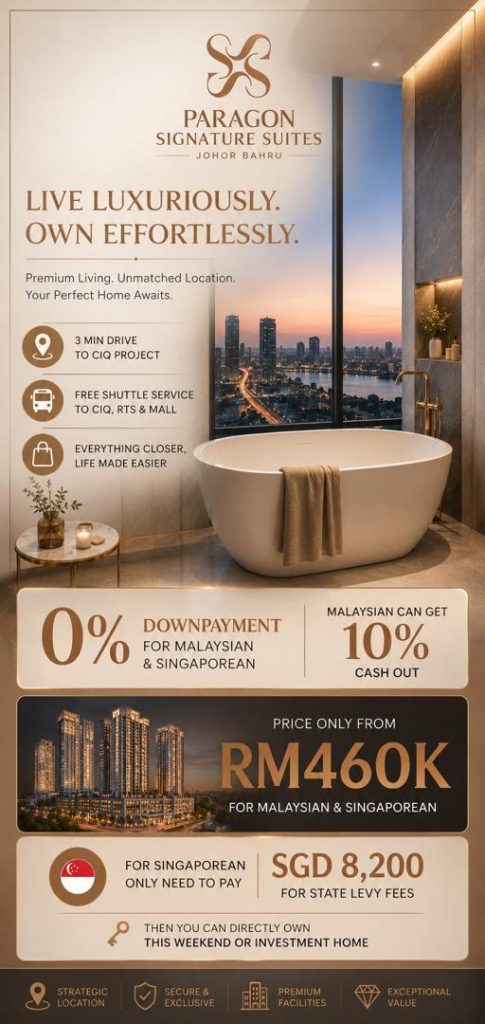
A hotel-style residence with an established hospitality framework can offer a more practical route for an overseas owner than self-managing guest turnover from another country. At Paragon Signature Suites JB, the optional Aurum Stay program is designed around managed distribution, guest support, housekeeping, maintenance, and monthly reporting. Owners considering a collective revenue pool should still review the commercial terms closely, including the 80% owner net-profit share, the 20% management share, and shared operating cost allocations.
No rental program should be treated as a guaranteed return. Occupancy, room rates, operating costs, competition, guest reviews, and travel demand all affect performance. Professional management can reduce daily workload, but it does not remove normal market risk. The advantage is operational clarity: owners know who is responsible for furnishing, bookings, guest communication, and the guest experience.
A Better Way to Assess Your Purchase Readiness
Before selecting a unit, organize your decision around the full ownership journey. First, verify that your nationality and chosen unit meet the current foreign ownership requirements. Next, confirm the purchase-price threshold and expected state-consent process. Then establish whether your funds, financing, and currency plan can support the purchase and related costs.
Finally, separate your personal-use expectations from your rental expectations. If you plan to stay in the unit periodically, ask how owner stays work during high-demand dates. If rental income is a priority, assess the building’s guest-facing standards, booking reach, maintenance process, and reporting discipline.
The most satisfying foreign purchase is rarely the one that looked best in a brochure alone. It is the one where eligibility, ownership costs, location, and management model were aligned before the paperwork began. When those details are clear, a compact Johor Bahru suite can become more than a cross-border property purchase – it can be a polished personal retreat with a purposeful place in your wider investment plan.
4 Responses