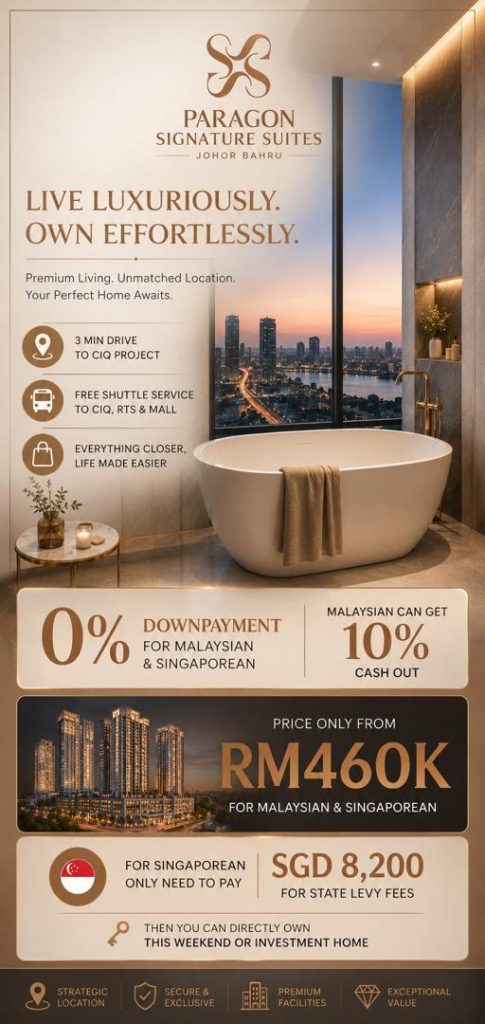
A Johor Bahru suite can be a practical home base, a weekend address, or a professionally managed rental asset. But for a Singapore-connected buyer, the purchase decision is only half the equation. Secure cross border financing means arranging funding that remains comfortable after exchange rates move, documentation is reviewed, and the property enters its operating phase.
The strongest financing plan is not simply the one with the highest approved loan amount. It is the plan that protects liquidity, accounts for currency exposure, and leaves room for the costs that arrive before and after handover.
What secure cross border financing really means
Cross-border property financing involves more than borrowing in a different country. Buyers may earn in Singapore dollars, hold assets across markets, and purchase a Malaysian property priced and financed in ringgit. Each of those moving parts affects affordability.
A secure structure begins with clarity on four areas: the lender’s eligibility requirements, the buyer’s available down payment and reserves, the currency used for repayments, and the full acquisition cost. This is especially relevant for first-time foreign buyers, who may focus on the advertised property price while underestimating legal fees, stamp duties, insurance, valuation costs, and furnishing or management expenses.
For an investment-oriented purchase, there is another layer. Short-term rental income can support the ownership experience, but it should not be treated as guaranteed loan repayment capacity. Occupancy, room rates, seasonality, platform fees, and operating expenses can change. A sound plan should remain manageable even during quieter booking periods.
Start with your ownership purpose
Before comparing lenders, decide whether the suite will primarily be an own-stay residence, an occasional city base, or a rental-led asset. Your answer shapes the cash flow you need to preserve.
An owner-occupier may prioritize predictable monthly repayments and access to emergency savings. A buyer who expects to spend time between Singapore and Johor Bahru may value the convenience of a manageable one-bedroom layout close to CIQ and the RTS corridor. An investor may be more focused on the relationship between financing costs, expected net rental income, and professional operating support.
These goals can overlap, but they should not be blended into one optimistic spreadsheet. Keep personal housing costs separate from projected rental revenue. If you plan to participate in a managed rental program, review how revenue is calculated, which expenses are shared, and when owner statements are issued. Clear operating information makes it easier to judge whether the property can complement, rather than carry, your financing commitments.
Know where the funding can come from
For many foreign purchasers, a Malaysian bank loan is the most direct route because the property and loan are both denominated in ringgit. Approval criteria, financing margins, interest or profit rates, loan tenure, and required deposits vary by bank and by borrower profile. Foreign-buyer policies can also differ from local-buyer policies.
Some buyers use a larger cash contribution rather than maximizing leverage. This can reduce monthly repayment pressure and may make the loan application more straightforward. The trade-off is lower liquidity. Capital committed to the purchase is capital that cannot be used for investments, emergencies, or a future business opportunity.
Others may consider using assets or borrowing capacity in Singapore. This can be appropriate in selected situations, but it introduces an additional question: are you matching the currency of your debt to the currency of the property and its income? There is no universal answer. A buyer paid in Singapore dollars may be comfortable servicing a ringgit loan from regular income, while another may prefer a different structure because of existing liabilities or long-term plans.
This is where independent legal, tax, and financial advice matters. Financing should be assessed alongside your residency status, income documentation, existing debt, and the rules that apply to foreign ownership and lending at the time of purchase.
Build a currency buffer, not just a payment schedule
Currency movement is one of the most overlooked parts of secure cross border financing. A monthly repayment can look attractive in ringgit, yet its effective cost in Singapore dollars may rise if the exchange rate changes. The reverse can happen as well, but conservative buyers plan for the less favorable scenario.
Instead of testing affordability at one exchange rate, model a range. Ask what happens if the ringgit strengthens against the currency in which you earn. Then include property-related costs that may be paid in ringgit, such as maintenance charges, utilities, repairs, insurance, and cleaning if the unit is rented.
A practical approach is to maintain a ringgit reserve dedicated to several months of repayments and property expenses. The right amount depends on your income stability, other commitments, and whether the unit is already generating income. This reserve reduces the need to convert funds at an unfavorable moment or rely on uncertain rental receipts.
Prepare documents before you find the perfect unit
Fast decisions are easier when your financial profile is organized. Lenders commonly ask for identification, proof of address, employment or business-income records, bank statements, tax documents, and details of existing debts. Self-employed buyers should expect closer review of business performance and may need additional supporting evidence.
Keep the source of your down payment clear and traceable. Cross-border transfers can require compliance checks, and unexplained movement of funds can slow down a transaction. If money is coming from savings, investment proceeds, a company distribution, or family support, retain the relevant records early.
You should also distinguish between the booking payment, the down payment, and transaction costs due at different stages. For a development under construction, financing can involve progressive releases tied to construction milestones. That may mean payments evolve before the suite is ready for occupation or rental. Ask for a stage-by-stage cash flow schedule rather than relying on a single monthly-payment estimate.
Match the loan to the property’s operating model
A compact suite with hotel-style services has a different ownership profile from a conventional long-term rental. Its appeal may include design, guest experience, booking visibility, housekeeping, and front-desk support. Those features can help create a stronger stay proposition, but owners should still study the commercial mechanics behind them.
At Paragon Signature Suites JB, the optional Aurum Stay model is designed to handle furnishing, guest support, housekeeping, maintenance, distribution, and booking management. For a buyer who does not want to operate an Airbnb-style unit personally, this can reduce the day-to-day burden. The financing question remains separate: understand the stated revenue-sharing arrangement, shared operating costs, and timing of net-profit distributions before incorporating any income into your personal budget.
A well-managed rental program can make ownership more hands-off. It cannot remove market risk. Compare your repayment obligation against a conservative rental case, not only peak-season performance. If the numbers work with modest occupancy and you still retain cash reserves, the purchase is on firmer ground.
Questions to ask before committing
A lender or sales representative should be able to help you identify the practical details that affect your decision. Ask whether the quoted financing margin is available to foreign buyers, whether the rate is fixed or variable, and how repayments may change over time. Confirm every upfront cost and whether any additional documentation is needed for overseas income.
For the property itself, ask when handover is expected, what is included in the unit, what recurring charges apply, and whether short-term rental activity is permitted under the development’s governing rules. If a management program is offered, request a clear explanation of owner reporting, expense allocation, owner-use arrangements, and how bookings are distributed.
Treat approval as a starting point, not a green light
Loan approval tells you what a bank may be willing to lend. It does not decide what you should comfortably borrow. The more useful number is the monthly commitment you can carry while preserving an emergency fund, meeting your current obligations, and allowing for exchange-rate movement.
For cross-border buyers, disciplined financing creates more freedom later. It lets you enjoy a refined residence, benefit from Johor Bahru connectivity, and pursue rental income without forcing the asset to perform perfectly every month. Choose a structure that gives your property room to become an opportunity, not another source of pressure.