
A one-bedroom home in Johor Bahru can cost less than a comparable Singapore apartment while placing owners within reach of the CIQ, future RTS connection, shopping districts, and weekend city life. That is the appeal behind Malaysia property for Singaporeans. But a lower entry price is only the starting point. The right purchase depends on ownership eligibility, carrying costs, rental rules, currency exposure, and whether the property suits your actual reason for buying.
For some buyers, the goal is a personal city base that feels more generous than a hotel room. For others, it is a managed asset that can welcome short-stay guests when the owner is away. These are different strategies, and a property should be assessed accordingly.
Why Singapore Buyers Look to Johor Bahru
Johor Bahru offers a combination that is difficult to ignore: proximity to Singapore, a broad choice of newer residences, and more attainable price points for foreign buyers than many mature Singapore districts. A compact, well-designed one-bedroom can provide meaningful space for a single professional, a couple, or occasional family stays without requiring the commitment of a large second home.
Connectivity matters as much as the address. Properties with practical access to CIQ, major retail destinations, transport routes, and the RTS corridor can be more convenient for owner use and more visible to short-stay guests. Still, “near Singapore” is not enough on its own. A buyer should consider the real journey at peak periods, the availability of shuttles or ride-hailing, and whether the neighborhood has reasons for guests to stay beyond border proximity.
Lifestyle is another part of the equation. A residence with a well-run lobby, fitness areas, pool facilities, security, parking, and thoughtful common spaces can feel more like a hotel-style condominium than a basic investment unit. That experience influences both personal enjoyment and guest reviews.
Malaysia Property for Singaporeans Starts With Eligibility
Foreign ownership rules in Malaysia are set through a mix of federal policy and state-level requirements. Singaporeans can generally purchase qualifying residential property, but minimum purchase prices, state consent requirements, property categories, and restrictions can change. In Johor, foreign-buyer thresholds and applicable rules should be confirmed directly with a qualified Malaysian lawyer and the relevant authorities before a booking fee is paid.
This is not a detail to leave until later. A unit may be attractively priced yet fall below the foreign ownership threshold, be subject to a title-related restriction, or require approval that affects the transaction timeline. New developments may also have specific allocation policies for foreign purchasers.
Before committing, ask for clarity on the unit’s title, foreign purchaser eligibility, the expected state consent process, and the full sale and purchase timeline. Your legal adviser should explain the documents required, including identity documents, proof of funds, and any forms needed for the purchase.
A foreign purchase also involves costs beyond the selling price. Buyers should budget for legal fees, stamp duty, state consent-related charges where applicable, financing expenses if borrowing, insurance, furnishing, utility deposits, and recurring maintenance fees. If the property will be rented, include the cost of preparing it to a guest-ready standard rather than assuming a partially furnished unit will automatically perform well online.
Decide Whether You Are Buying a Home, an Asset, or Both
The strongest purchases begin with an honest use case. If you expect to stay often, prioritize layout comfort, storage, parking, building service, and the ease of arriving after a cross-border journey. A one-bedroom of roughly 645 to 649 square feet can offer a more livable format than a small studio, especially when it has a defined bedroom, practical kitchen area, and space to work or host a friend.
If income is central to the decision, assess the unit as a hospitality product. Guests compare listings in seconds. They notice interior design, clean arrival experience, Wi-Fi reliability, bedding, lighting, building amenities, check-in support, and the quality of listing photography. A cheap unit that needs constant owner intervention can become more expensive in time and lost bookings.
Many buyers want both flexibility and income. That can work well when short-term rental is permitted by the development, managed professionally, and supported by a clear operating model. It does not work as well when the owner expects peak nightly rates all year, overlooks cleaning and utility costs, or has no plan for guest support.
Understand Short-Term Rental Before You Rely on It
Short-term rental income is variable. Demand shifts with school holidays, business travel, events, border traffic, competing inventory, and the wider economy. A responsible projection should use conservative occupancy and rate assumptions, not only the best-performing holiday periods.
You should also verify whether the development’s management rules and local requirements allow the intended rental activity. A residence that is Airbnb-friendly in principle should still have a practical framework for guest registration, access control, housekeeping, noise management, and owner reporting. Those operational details protect the guest experience and the value of the community.
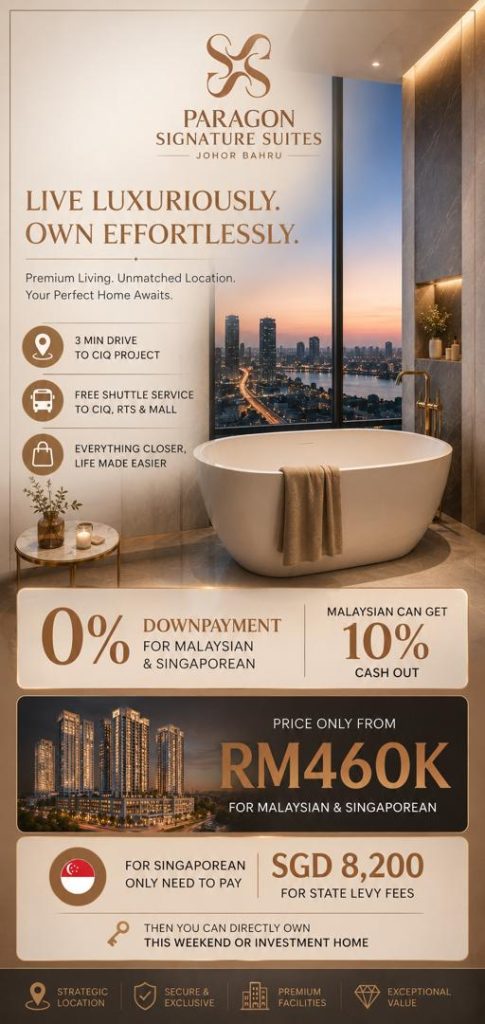
A managed program can reduce the work of ownership. At Paragon Signature Suites JB, Aurum Stay is structured to cover furnishing coordination, interior design, guest support, housekeeping, maintenance, listing distribution, and booking management. Owners participating in its collective short-term rental pool receive 80% of net profit, while management receives 20%, with shared cleaning, maintenance, and utility operating costs allocated transparently at 15%.
That structure may appeal to an owner who does not want to answer late-night messages, coordinate cleaners, or manage a calendar across multiple booking platforms. Yet buyers should still ask what “net profit” includes, how monthly statements are presented, how owner-use dates are handled, and what happens during lower-demand periods. Professional management can create consistency, but it does not eliminate market risk.
Factor In Currency, Financing, and Exit Timing
A Malaysian property is priced and operated in Malaysian ringgit. Your purchase funds, maintenance fees, rental income, and eventual sale proceeds are therefore exposed to exchange-rate movements if your primary wealth and spending are in Singapore dollars. A favorable purchase price can look different once currency conversion, transfer costs, and future exchange rates are considered.
Some buyers pay cash for simplicity. Others explore financing from Malaysian banks or, in certain cases, cross-border banking relationships. Loan eligibility, loan-to-value ratios, interest rates, documentation, and repayment terms differ by borrower and institution. Obtain an in-principle view of financing before selecting a unit based on a payment plan that may not match your approval outcome.
Exit planning deserves equal attention. Ask how many comparable units will be available when the project is completed, whether the area has a deep resale market, and what buyer profile would purchase from you later. A unit with strong owner-occupier appeal may have a broader resale audience than one designed only around rental yield claims.
Malaysian tax treatment can also affect your return. Rental income may be taxable, and gains on a sale may be subject to the Real Property Gains Tax framework depending on the holding period and prevailing rules. Tax residency and reporting obligations can be complex for cross-border owners, so obtain advice tailored to your circumstances rather than relying on a general online calculation.
Questions to Ask Before Reserving a Unit
A polished showroom is useful, but the purchase decision should be supported by documents and operating facts. Ask for the projected completion schedule, maintenance fee estimate, sinking fund contribution, parking arrangement, furnishing specification, and any restrictions on renovation or rentals. If the unit is marketed for managed stays, request a sample monthly owner statement and a clear explanation of every deduction.
Also ask how the building will serve real residents. A 24-hour front desk, pre-cooled arrival, welcome service, and reliable housekeeping can elevate the ownership experience, particularly for Singapore-based buyers making short visits. But the core question remains practical: will the residence be easy to use, easy to maintain, and compelling to a future buyer or guest?
The best Malaysia property purchase is not simply the one with the lowest entry price. It is the one whose legal eligibility, location, layout, costs, and management model all support the life and investment role you expect it to play. Take time to test those assumptions before signing, and you will be buying with a clearer view of what the property can genuinely deliver.
One Response